
Zero Trust, Step Zero: The 3 Key Priorities Every CISO Should Know
Posted: Tuesday December 16, 2025
Author: Numberline Marketing
Across industries and companies of every size, CISOs tend to ask the same question when it comes to Zero Trust: “Where do we start?”
It’s a fair question. Zero Trust touches multiple pillars and is surrounded by a growing ecosystem of vendors, frameworks, architectures, and approaches. The result is a landscape where every path appears possible, but none are completely obvious.
Without an intentional starting point, most organizations fall into familiar traps: choosing tools before defining requirements, launching isolated projects that don’t add up to a program, or piloting capabilities that stall because they lack context and sponsorship.
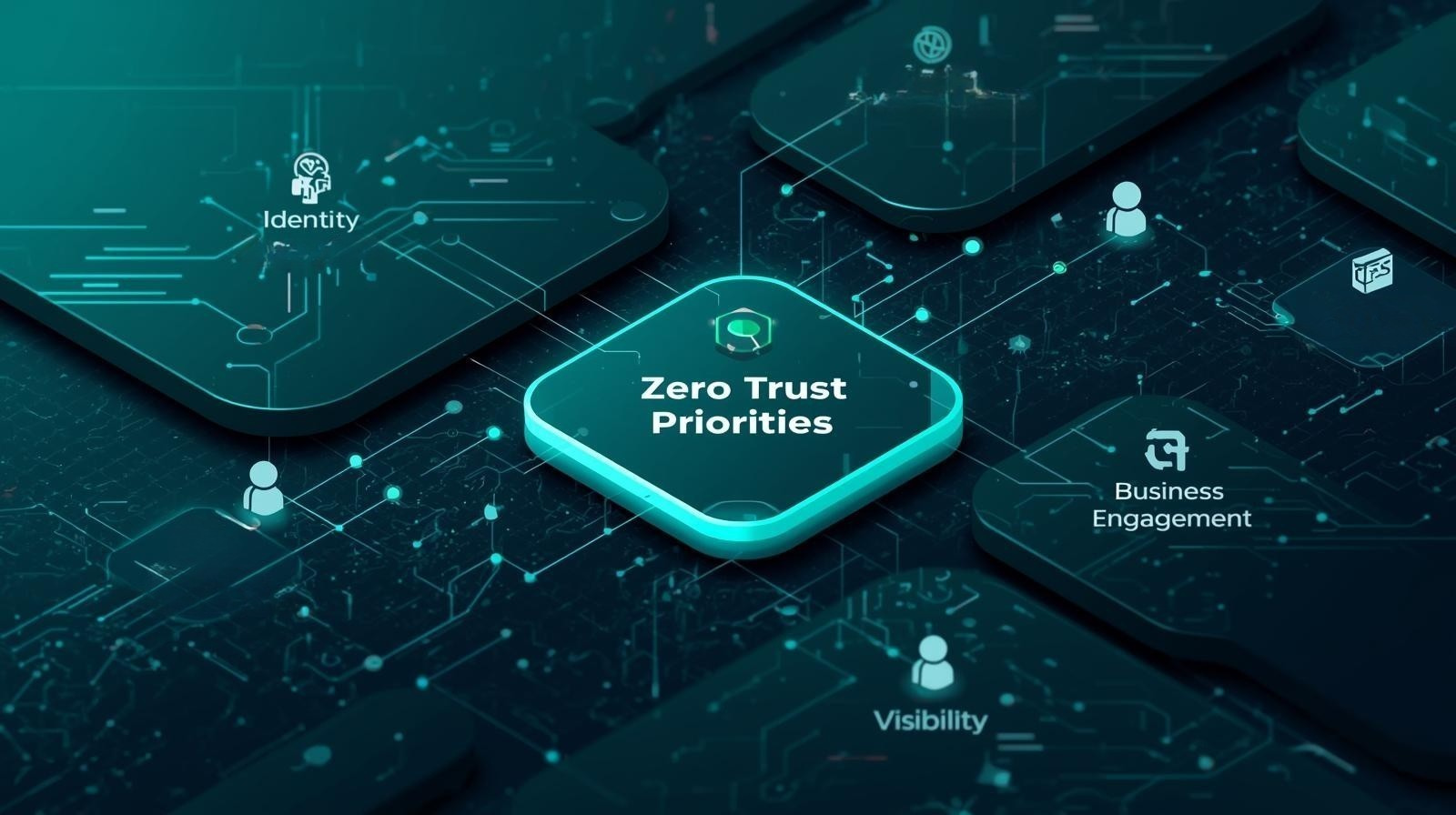
To avoid these pitfalls, a Zero Trust initiative needs structure from the very beginning. And the most effective place to start is with three foundational program priorities: Identity, Business Engagement, and Visibility.
These are the conditions that make meaningful Zero Trust progress possible. Everything else—policies, safeguards, vendor choices, architecture, roadmaps—depends on getting these priorities right.
Why Starting with Priorities Matters
Before a CISO can choose technologies, sequence a roadmap, or justify budget, the program needs clarity on three things:
- What will drive policy?
(Well-run systems use a combination of identity attributes, resource criticality, risk context, device posture, and other signals) - Who must be involved?
(Not just security but application owners, business leaders, data stewards, and process teams.) - What must be understood about the environment?
(How things work today, how they interact, and where implicit trust exists.)
Identity, Business Engagement, and Visibility provide this clarity. They shape every downstream decision and prevent the initiative from veering into reactive work or vendor-led direction.
Without them, Zero Trust becomes abstract. With them, Zero Trust becomes executable.
Priority #1: Identity
Why identity must come first:
Identity is the backbone of Zero Trust. Every access decision—for a user, service, API, device, or workload—depends on accurate and authoritative identity data.
If identity is inconsistent, duplicated across systems, or missing the attributes required for policy, Zero Trust stalls before it even begins.
What CISOs should prioritize:
- Establishing authoritative identity sources
- Defining and enforcing governance processes to obtain reliable identity information on which to make access decisions
- Reducing identity silos across applications, cloud services, and directories
- Strengthening authentication and ensure reliable identity signals
- Defining how identity attributes will inform access policy
- Understanding which identities interact with which business assets — and capture those relationships in attributes, roles, and policies
Why identity first matters:
Identity drives the enforcement plane. Without identity clarity:
- Policies become overly broad or overly restrictive.
- Automation is limited.
- Risk-based decisions are impossible.
- Access controls cannot be consistently applied.
Zero Trust cannot function without strong identity foundations. Starting here eliminates rework and sets the stage for scalable policy.
Priority #2: Business Engagement
Why Zero Trust can’t be built solely within the security team:
Zero Trust changes how applications are accessed, how processes run, and how users interact with systems. Without early input from stakeholders, the initiative risks creating friction or disrupting workflows.
Business engagement also strengthens sponsorship. When leaders understand how Zero Trust supports continuity, resilience, and productivity, and how it supports their business incentives and goals, they are far more likely to champion the program.
What CISOs should prioritize:
- Identifying critical business assets
- Engaging owners of applications, processes, and data
- Understanding business initiatives, dependencies, and operational friction points
- Aligning Zero Trust outcomes with business objectives
Why business engagement is a starting priority:
Business engagement provides essential context for:
- Prioritizing assets
- Sequencing deployment and policy enablement
- Writing effective policies
- Designing a realistic roadmap
It also helps overcome organizational inertia, the natural resistance to change that exists in nearly every enterprise.
Without cross-functional alignment, Zero Trust becomes a technical exercise with limited impact. With alignment, it becomes an enterprise strategy.
Priority #3: Visibility
Why visibility must precede enforcement:
Zero Trust depends on facts, not assumptions. To create meaningful policies and avoid disrupting operations, CISOs need visibility into how the environment actually behaves today, and what activity is expected and should be permitted.
This includes insight into:
- Assets
- Identities
- Protect surfaces and transaction/data flows
- Application dependencies
- Network interactions
- Device posture
What CISOs should prioritize:
- Identifying business assets and ensuring accurate inventory information
- Understanding communication paths between systems
- Identifying areas where implicit trust currently exists
- Establishing telemetry to support continuous verification
Why visibility is foundational:
Visibility reveals:
- Where the risks are
- What dependencies must be preserved
- Which policies are feasible
- Where to focus early efforts
- How to avoid breaking business operations
It also provides the factual basis for sequencing the Zero Trust roadmap intelligently.
How These Priorities Work Together
Identity, Business Engagement, and Visibility are distinct, but they are not independent. Each strengthens the others and together they form the foundation for any effective Zero Trust program:
- Identity supplies the signals and attributes required for policy enforcement.
- Business Engagement ensures policies and priorities align with real workflows, assets, and operational needs, and that the initiative has the support required to move forward.
- Visibility provides the insight needed to understand dependencies, uncover risk, and design policies that are both secure and practical.
When combined, these priorities give CISOs a clear, structured pathway for defining safeguards, sequencing capabilities, and building a Zero Trust program that is aligned, sustainable, and impactful.
Start with Focus, Not Tools
Identity, Business Engagement, and Visibility form the essential starting point for Zero Trust. They provide the clarity required before making technology selections and ensure the program is driven by organizational needs — not vendor claims or one-off technical projects.
Beginning here transforms Zero Trust from an abstract aspiration into a structured, executable program.
If you’re shaping your Zero Trust starting point or validating your program’s foundation, join our upcoming webinar, “Applying the Zero Trust Blueprint: A Practical, Comprehensive Guide for the Enterprise,” where we’ll explore how to operationalize these priorities effectively across the enterprise.